


|
Navigation
Search
|
10 Humanoid Robot Facts That Make the Future Feel Uncomfortably Close
Monday December 15, 2025. 09:11 PM , from eWeek
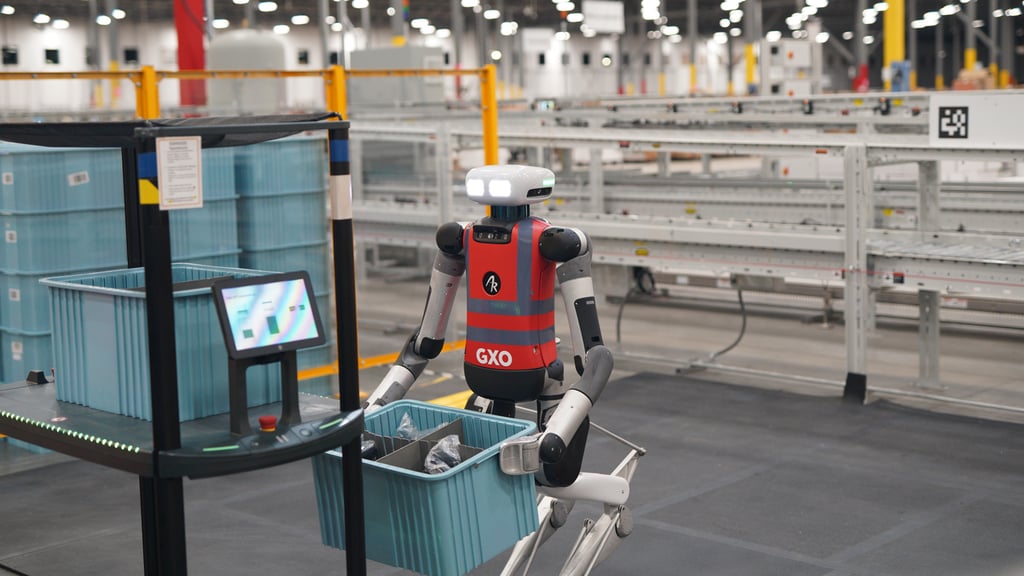
2025 looks different. The fascinating stories are not just about stunts, but about handling actual work in warehouses, factory trials measured in hours, and price points executives will actually put in a budget. This year, humanoids began trading spectacle for repetition, and repetition is where real technology either breaks or becomes infrastructure. Here are 10 humanoid robot facts that show what changed, and why the next chapter is less sci-fi than you think. 1. A humanoid robot has already moved over 100,000 totes Digit working at a GXO facility. Image: Agility Robotics Agility Robotics said its Digit humanoid has already moved 100,000+ totes in live commercial work at a GXO facility in Flowery Branch, Georgia. That is the kind of milestone warehouses pay attention to, because tote handling is the gritty, repetitive backbone of the whole operation. It is where automation either proves it can keep up or quietly gets sidelined. Hitting that number tells a bigger story than a flashy demo ever could. It means the robot is staying online, doing real shifts, and fitting into everyday workflows instead of running a single polished test. It is a small but telling sign that humanoids are starting to pull their weight in the exact kind of high-volume, no-nonsense jobs that define warehouse reality. 2. A humanoid completed 110 distinct store tasks for a retailer Phoenix humanoid at a retail store. Image: Sanctuary AI Retail is chaos compared to a lab: unpredictable objects, tight spaces, constant “exceptions,” and humans everywhere. According to Sanctuary AI, its Phoenix humanoid completed 110 retail-related tasks in a week-long pilot at a Mark’s store, performing everything from picking and packing to tagging, folding, and cleaning. The pilot proved that “general-purpose” is starting to mean something outside a controlled environment. 3. Robot models are getting retired like phone generations Image: Figure AI Humanoids are starting to look less like one-off prototypes and more like product lines with planned turnover. Figure said that after releasing Figure 03, it’s beginning a fleet-wide retirement of Figure 02, treating real-world deployments as learning cycles that get rolled into the next “generation.” 4. Mercedes is testing humanoids in multiple countries Apollo humanoids. Image: Apptronik Mercedes-Benz isn’t just experimenting in one corner of one plant. Reuters reported that the carmaker is trialing Apptronik’s Apollo at its Berlin site and in Kecskemét, Hungary, with workers transferring know-how through teleoperation so the robot can learn tasks. Mercedes’ production chief suggested that humanoids become economically compelling around a “two-digit thousand-dollar” cost per robot. 5. Hyundai is planning robot orders in the tens of thousands Atlas. Image: Boston Dynamics According to Boston Dynamics, Hyundai Motor Group isn’t thinking small. It plans to buy tens of thousands of robots and work more closely with Boston Dynamics to scale up robot manufacturing. Hyundai also set aside $6 billion to push innovation and strengthen partnerships with US companies. Hyundai is already using Spot for industrial inspection and predictive maintenance, and Boston Dynamics says Atlas will eventually join factory floors as well. The company even pointed to its Metaplant America site in Georgia, where Spot will handle exterior quality checks, and Atlas is expected to appear as the partnership grows. It is a glimpse of how fast “future factories” stop sounding theoretical once the equipment is actually ordered. 6. China’s humanoid boom is so crowded that officials are warning about a bubble Image: iLexx/Envato When governments start saying “slow down,” it’s usually because the hype is outrunning demand. China’s top economic planner warned that with more than 150 companies building humanoids, the industry risks flooding the market with repetitive products, and that a bubble could form if production ramps faster than real orders. 7. The price floor dropped hard; one humanoid is around $13,500 Unitree’s G1 humanoid. Image: Unitree Humanoids used to live in the “lab equipment” price bracket. Unitree now lists its G1 humanoid at prices starting from $13,500, which puts a really small team number on the table. At that level, the conversation shifts from “who can afford a humanoid” to “what can you make it do that’s worth it.” 8. A robot in China walked 66 miles in three days, setting a new world record Image: Guinness World Records Endurance is the unglamorous bottleneck for humanoids. It’s not just “can it walk,” but “can it keep going” across long, messy, real routes. AgiBot’s A2 humanoid completed a 66-mile trek over three days, earning a Guinness World Records mark for the longest reported journey walked by a humanoid robot. And it’s the extrapolation that makes your brain itch. Sixty-six miles in three days is equivalent to 22 miles a day. If you extend that pace across a multi-year run, you’re suddenly talking well over 24,000 miles. 9. Humanoids raced humans in a half-marathon “Tiangong” robots running with athletes. Image: Beijing E-Town In April 2025, 21 humanoid robots ran alongside humans in Beijing’s E-Town half-marathon, an event that made for great visuals, but also exposed the practical reality. It showed that today’s humanoids still need lots of engineering support to handle heat, balance, navigation, and power over distance. The winner, Tiangong Ultra, finished in 2:40:42, which is impressive for a robot, but nowhere near elite human times. 10. The first World Humanoid Robot Games were a full-scale international event Humanoids playing soccer at the World Humanoid Robot Games. Image: This is Beijing/Facebook In August this year, the inaugural World Humanoid Robot Games in Beijing brought 280 teams from 16 countries to competitions spanning sports such as football and track. It also involved task-based challenges, such as cleaning and sorting medicines. The competitions took place in full-scale Olympic venues such as the National Speed Skating Oval, which gave the whole event a sense of seriousness rather than novelty. If two arms are good, six might be the new factory math. Midea just rolled out MIRO U, a six-armed humanoid designed to speed up real production. The post 10 Humanoid Robot Facts That Make the Future Feel Uncomfortably Close appeared first on eWEEK.
https://www.eweek.com/news/humanoid-robots-10-surprising-facts/
Related News
|

25 sources
Current Date
Jan, Tue 6 - 11:28 CET
|
 Read more at eWeek


